
Zanechat zprávu
Pokud máte zájem o nákladní vozy HOWO a chcete se dozvědět více informací, zanechte zde prosím zprávu, odpovíme vám do 8 hodin.


When inspecting a tanker truck, many buyers make the mistake of focusing solely on a shiny, flawless paint job. In reality, critical technical specifications,such as the proportion of welds subjected to non-destructive testing (NDT) and the actual measured wall thickness of the tank are far more important. A formal delivery process is more than just a verbal assurance,it is a commitment that places the responsibility for risk assessment squarely in the hands of the customer.
At our factory, a comprehensive vehicle inspection is an essential, mandatory procedure. Before any tanker truck is delivered, our inspectors verify key parameters: the results of radiographic testing on welds, wall thickness measurements taken at 24 designated points across the tank, and the electrical resistance of the anti-static grounding system. Every data point is meticulously documented in writing, allowing for a thorough, item-by-item verification against established standards.
Featured here is a Sinotruk HOWO NX 20,000 liter tanker truck. Today, we will conduct a quality inspection on it, a process that will also help you understand the standards required for a truly qualified tanker truck.
|
Drive Type |
Capacity |
Engine |
General specification |
|
6×4 |
20000L |
WD615.47, 370hp |
★CSC5253GJYEQ6 ★110 km/h ★12.00R20 18PR ★High quality steel body material ★Liquid Type: Gasoline / Diesel ★Operating ambient temperature:-20~50° |
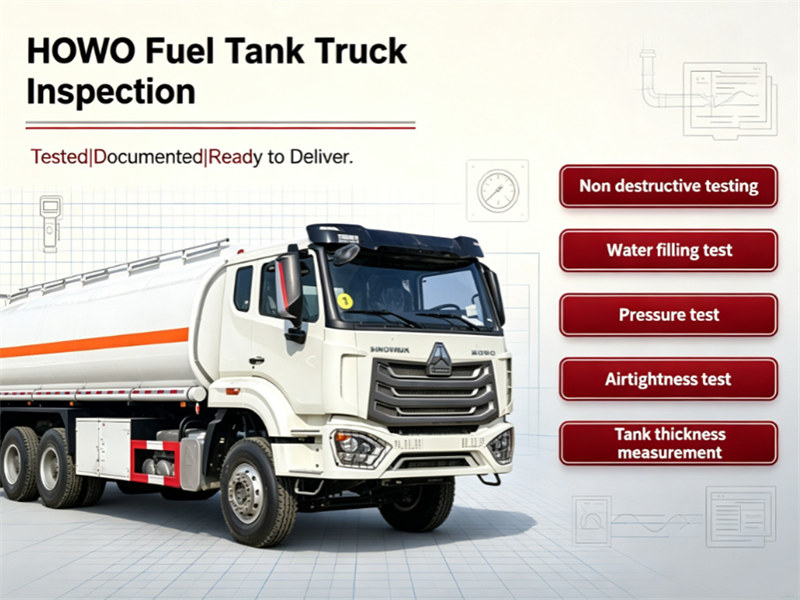
 The Significance of Inspection Reports :
✅ Full Traceability for Every Vehicle: Each report is linked to a unique VIN and product serial number. Should any questions arise later, you can trace the complete history,including all test records, material specifications, and inspection sign-offs, for that specific vehicle.
✅ Protecting Your Asset Value: A fuel tanker represents a significant capital investment with a 10 year service life. A comprehensive inspection report helps preserve the vehicle’s residual value. Furthermore, insurance providers and financial lessors require authentic inspection report,not mere verbal assurances,for accurate valuation.
✅ Early Detection of Hazards at the Factory: Issues such as weld defects, insufficient tank wall thickness, seal failures, or poor static electricity grounding are often difficult to spot with the naked eye. Through rigorous hydrostatic, tank thickness, and leak tightness testing, potential hazards are identified and addressed at the factory, preventing risks from surfacing only after the vehicle has been delivered to the site.
Inspection Process:
Inspection reports are not generated all at once at the end; rather, they are produced incrementally as each stage of the manufacturing process is completed. The sequence is strictly defined by the relevant standards,for example, a hydrostatic test must precede a pressure test, and pressure must be reduced before conducting inspections; performing these steps in the wrong order would render the resulting data meaningless.
 Re-inspection of Incoming Materials: Steel plates are verified against their material certificates and specifications by heat number; welding consumables are checked by batch and model. For this batch, Q235B steel is used for the tank shell and heads, with J422 welding electrodes and ER70S-6 welding wire.
2. Cutting, Forming, and Assembly: The minimum thickness of the formed heads and the wall thickness of the tank shell are established at this stage, which sets the upper limits for all subsequent thickness measurements.
3. Welding and Post Weld Treatment: Welding is performed according to the established welding procedure specification (WPS), with a weld joint coefficient of 0.85. Weld surfaces are cleaned and dried in preparation for the hydrostatic test and non-destructive testing (NDT).
4. Visual and Dimensional Inspection: This includes checks for overall vehicle dimensions, tank dimensions, straightness, angular misalignment and offset at Class A/B weld joints, weld reinforcement height, undercuts, and any deviation between the centers of the tank and the chassis.
5. Non-Destructive Testing (NDT): Radiographic testing (RT) is performed on 10% of the length of each weld joint, with 100% coverage for all weld intersections. Magnetic particle testing (MT) is applied to 100% of the areas surrounding openings, such as manholes, nozzles, and flanges.
6. Hydrostatic Test: The tank is filled with water (at a temperature of no less than 5°C) and monitored for 1 hour to ensure no leakage occurs on the outer surfaces of the welds; the tank is subsequently drained and dried.
7. Pressure Test: The internal pressure is raised to 0.042 MPa and held for 30 minutes, then reduced to the design pressure of 0.028 MPa and held for another 30 minutes. The tank is inspected to ensure there is no leakage, visible deformation, or abnormal noise.
8. Air Tightness Test: The tank is pressurized with compressed air to 0.036 MPa and held for 10 minutes to ensure there are no leaks at any weld joints or connection points.
9. Tank thickness measurement: Using an ultrasonic thickness gauge (model TT130, with an accuracy of ±0.01 mm), take measurements at 24 designated points as indicated in the measurement point diagram and record the results.
10. Testing of accessories and the complete unit: Verify the opening pressure of emergency relief devices and breather valves; test the sealing performance and automatic shut-off function of emergency shut-off valves; conduct pressure and leak-tightness tests for each of the two loading/unloading hoses; verify the load-bearing capacity of the ladder (1960 N),and measure the electrical resistance across the six paths provided for static electricity dissipation.
|
Test item |
Standard / drawing requirement |
Measured on this unit |
|
Tank hydrostatic test |
0.042 MPa held for 30 min, then reduced to 0.028 MPa and held another 30 min |
No leakage, no visible deformation, no abnormal noise |
|
Air-tightness test |
0.036 MPa, held 10 min, no leakage |
No leakage at welds or connections |
|
Water-fill test |
Medium ≥5 °C, tank filled for 1 h, no seepage at welds |
Medium 9 °C, 1 h, no seepage |
|
Shell wall thickness |
≥5.10 mm after forming |
Min. 5.20 mm |
|
Head wall thickness |
≥5.10 mm after forming |
Min. 5.75 mm |
|
Tank straightness |
≤2‰ of tank length and ≤20 mm |
5 mm |
|
Class A weld angular deviation |
≤5 mm |
1.8 mm |
|
Class B weld angular deviation |
≤5 mm |
2.0 mm |
|
Weld misalignment |
≤1.14 mm |
Class A 0.6 mm, Class B 0.5 mm |
|
Weld reinforcement height |
0–1.5 mm |
0.9 mm |
|
Tank-to-chassis centre offset |
≤6 mm |
2 mm |
|
Static-discharge resistance |
All six paths ≤5 Ω |
0.3–0.8 Ω |
|
Emergency vent device |
Opens at 21–35 kPa (DN250, 2 pcs) |
Opens at 30 kPa |
|
Breather valve |
Intake −2 to −4 kPa, exhaust 6–12 kPa (DN40, 2 pcs) |
−3 kPa / 7 kPa |
|
Emergency shut-off valve |
Body 0.66 MPa/60 s without leakage; seat 0.05 MPa/60 s without visible leakage; auto-closes on air loss |
All three passed |
|
Loading / unloading hoses |
0.084 MPa/5 min without rupture; 0.056 MPa/5 min without leakage |
Both hoses tested individually, all passed |
|
Ladder load test |
Width ≥350 mm, step ≤350 mm, tread load ≥1960 N |
350 mm / 350 mm / 1960 N with weights |
|
Capacity |
Deviation from published capacity ≤3% |
Passed by weighing |
A fuel tanker truck is a vehicle used for transporting high risk materials. Its quality is not defined by marketing slogans, but by a set of verifiable data. While a buyer may not be able to personally monitor every step of a pressure test, they can verify key parameters,such as the "minimum wall thickness of 5.20 mm" (measured across 24 designated points), a test pressure of "0.042 MPa" maintained for "30 minutes," and the use of a pressure gauge with a valid, up-to-date calibration certificate.
Adhering to standardized testing procedures is a core practice at CS Trucks Group; it serves as a self-imposed discipline that ensures we consistently deliver high-quality products.
 IPv6 SÍŤOVÁ PODPORA
Zanechat zprávu
Skenování do WeChatu/WhatsAppu :


 čeština
 English
 Français
 Deutsch
 Русский
 Italiano
 Español
 Português
 Nederland
 日语
 한국어
 Türk
 Ελληνικά
 แบบไทย
 Magyar
 Indonesia
 Tiếng Việt
 عربي
 Қазақстан
 မြန်မာ
 Filipino
 kiswahili
 Türkmenler
 o'zbek
 Кыргызча
 українська
 Slovák
 Română
 فارسی
 hrvatski
 Svenska
 中文


